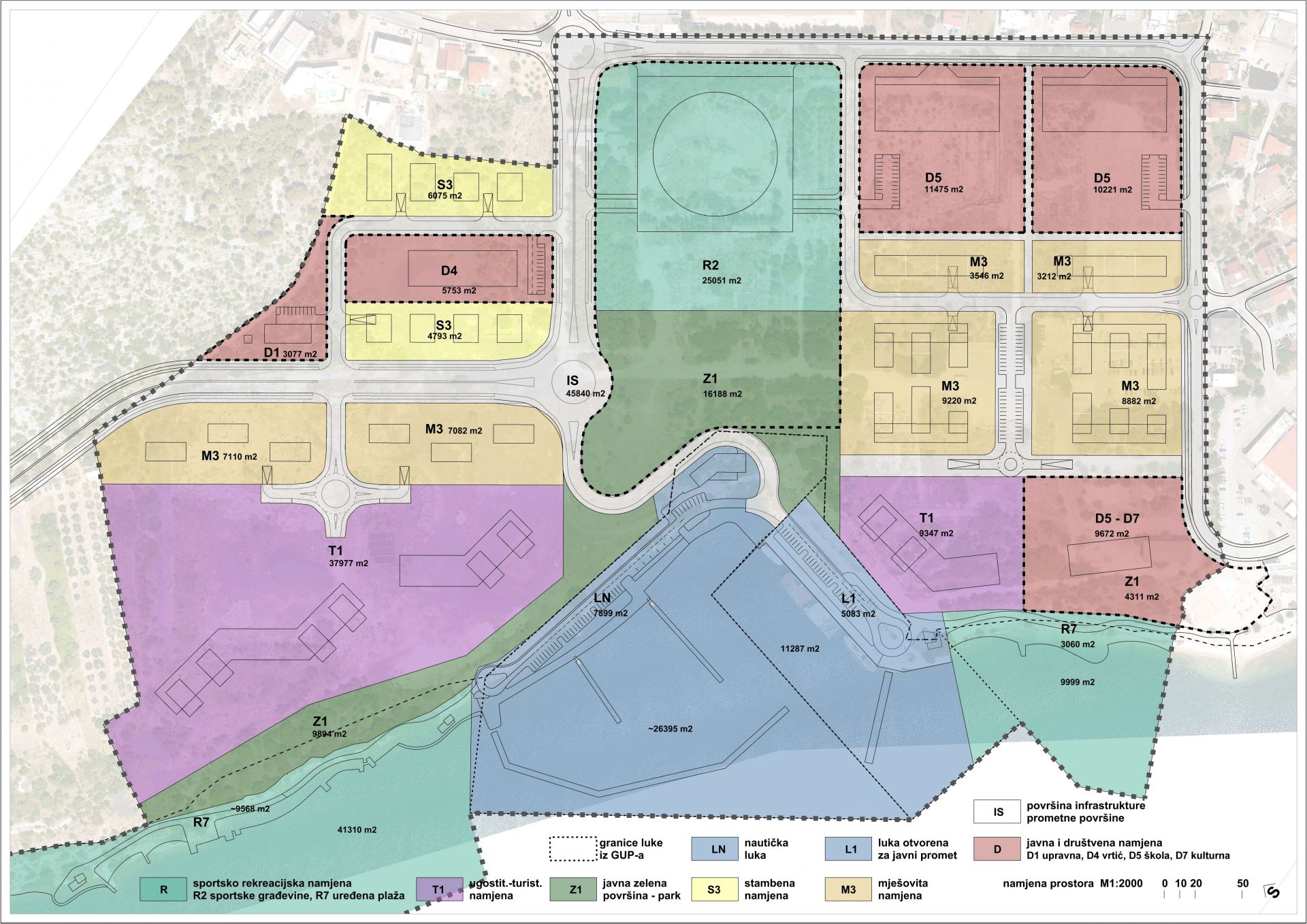
Coexistence of Public and Private
The proposed conceptual design defines spatial capacities and provides key guidelines for the development of the Detailed Urban Plan (UPU). A mixed-use development is planned for the former industrial site, transforming the degraded area into a vibrant, integrated urban district.
Sustainable Mobility and Pedestrian Zones
The development is grounded in opening up the waterfront, which is currently inaccessible. A new pedestrian network and green landscape connect Batižele with Crnica and the rest of the city:
- Unrestricted movement: Pedestrians can move freely from the viewing point integrated into the music school, across the spacious green beach, and all the way to the tourism zone;
- Natural continuity: Pedestrian paths extend logically across I. Meštrović Street into Crnica, or through the tourism zone towards Smričnjak Hill;
- Green heart: A large central park dominates the public space, both visually and organizationally.
Public and Social Facilities
All public facilities are arranged to ensure maximum safety and accessibility for pedestrians, eliminating the need for dangerous road crossings:
- Educational zone: The kindergarten, primary school, and secondary transport school are equally accessible to residents of both Crnica and Batižele;
- Music school: Situated at an attractive vantage point atop the cliff (a "prime waterfront location"), it highlights Šibenik’s distinctive musical identity;
- Community safety: The fire station is positioned to ensure rapid, unobstructed emergency access to main roads.
Multifunctional Hall
A multipurpose hall is planned as a key regional facility. It will host sports, musical, and cultural events, with a particular focus on the winter season, addressing Šibenik’s current lack of a suitable venue for year-round programming.
Maritime Facilities and Beaches
The area of the former industrial port is being transformed into a modern zone for public maritime transport and tourism:
- Public Port: Dedicated docking facilities for seasonal boat lines and water taxis;
- Marina: A small nautical tourism port located north of the public port;
- Developed Beaches: Coastal areas will extend the city’s public swimming zones, stretching from Banj Beach westward toward the Šibenik Bridge.
Tourism and Housing Tailored to Dalmatia
- Commercial Facilities: The developed waterfront is reserved for a city hotel featuring extensive hospitality amenities, as well as hotels near the marina;
- Architecture Reflecting the Local Spirit: Residential zones are situated in the remaining plots. Taller buildings are planned at the foot of Smričnjak Hill, while zones closer to the city feature denser layouts with atriums and rooftop terraces, reflecting the spirit of a traditional Dalmatian town;
- Preservation of Views: Building heights in residential zones are strictly controlled to fully preserve Šibenik’s historic skyline and the view of the Cathedral of St. James’s dome.